How to Play
A five-minute tour through a single round of Soccards: the pitch, your hand, the card types, and how the dice fall when both players reveal.
The match in one paragraph
Soccards is a two-player tactical card game that simulates a full 90 minutes of football in 6–10 real minutes. Each round, both players plan their moves privately, confirm, and reveal at the same time. Cards push points up or down in three zones (defence, midfield, attack), and the margin between sides decides who keeps the ball, advances on the pitch, or scores.
You don't roll a die or shuffle for surprises. You read your hand, read the moment, and commit. Then the football happens.
The pitch
The pitch is split into three zones from your perspective: defence, midfield, attack. Your defence is your opponent's attack and vice versa. The active zone is always one single place on the field where this round will play out.
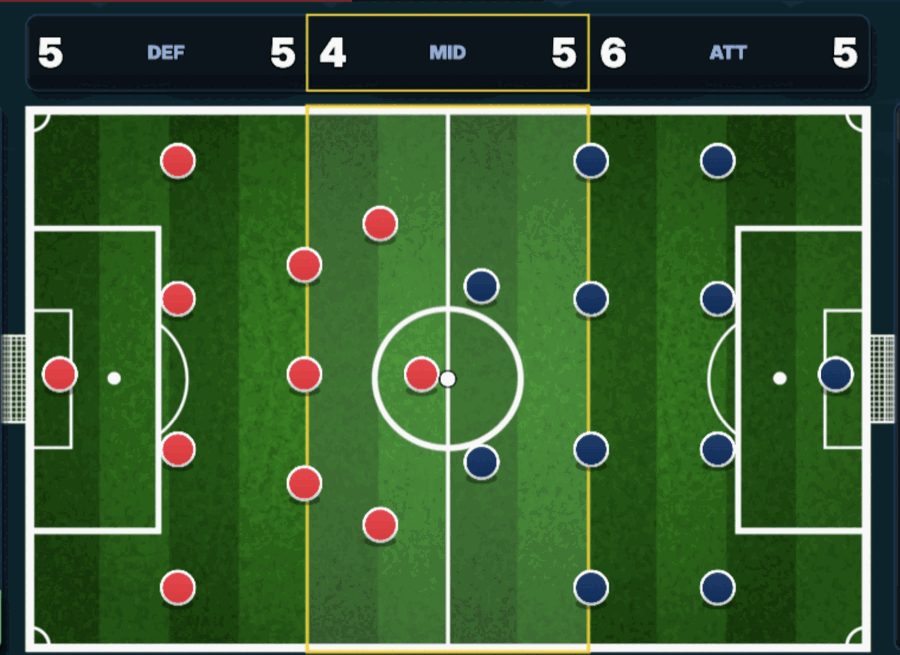
The formation you picked before kickoff sets your base points in each zone. A 4-4-2 distributes 5/5/5; a 4-3-3 leans attack at 5/4/6; a 5-3-2 leans defence at 6/5/4, and so on. See the Tactical Guide for the full table.
Possession belongs to exactly one side at any moment. When you have it, you want to advance toward attack and shoot. When you don't, you want it back.
Your hand
Your hand always contains eight cards:
- 5 primary cards: dark blue background. These are the moves like passes, shots, tackles, and presses.
- 3 support cards: white background. Modifiers and events that layer onto your primary play.
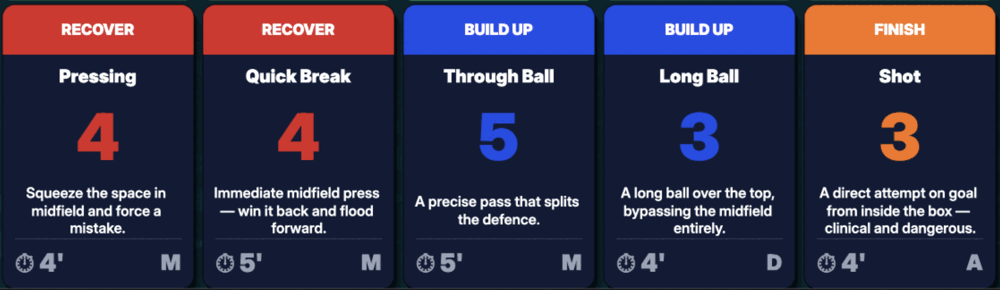
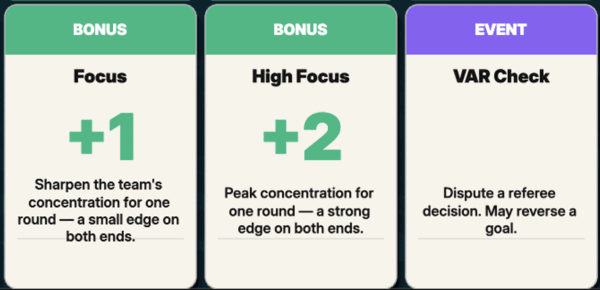
After each round, the hand refills back to 5 + 3. You'll always have eight cards to work with at the start of the next round.
A round, step by step
- Phase 1, Discard (optional). Look at your hand and mark up to two cards you don't want. When you confirm, replacements are dealt immediately. You'll play Phase 2 with the refreshed hand. Skip the phase entirely if you like what you've got.
- Phase 2, Plan your play. Choose up to one primary card and up to one support card. The play list shows a live preview of how your zone points will look after the cards land.
- Confirm. Press the confirm button (it reads "PLAY 2 CARDS" or similar). Your plan locks in. The opponent does the same in parallel.
- Reveal. Both sides show their played cards simultaneously.
- Resolve. The game compares points in the active zone, computes the margin, rolls once, and shows the outcome with commentary. The clock advances.
Card types
Primary cards split into three roles:
- Build up: attack-value cards used in your defence and midfield zones to advance with the ball. Only playable when in possession. Examples: Structured Play, Forward Pass, Long Ball.
- Recover: defence-value cards used to win the ball back. Only playable when not in possession. Examples: Tackle, Pressing, Low Block.
- Finish: attack-value cards played in the attack zone to take a shot at goal (Long Shot also fires from midfield). Examples: Shot, Header, Long Shot.
Support cards come in two flavours:
- Bonus: stack +1 or +2 onto attack or defence, or shift the time advance by ±1 minute. Time modifiers only apply when your side wins the round.
- Event: triggers a special effect. VAR Check re-rolls an opponent goal, Tactical Change schedules a new formation, Time Wasting bleeds two extra minutes off the clock.
How a round resolves
Each side's score in the active zone is base zone points plus their played primary card (if any) plus their bonus card (if any). The resolution then branches:
Regular resolution
When the round is anywhere except a shot on goal, the game compares the in-possession side against the not-in-possession side. The bigger the margin in your favour, the more likely you'll get the outcome you want.
If the possessor wins, the zone advances one step toward their attack (defence → midfield → attack). If the defender wins, possession flips and the zone holds. A handful of specialty cards can skip a zone on a decisive win (Long Ball, Quick Counter, Quick Break).
Attack resolution
When the in-possession side plays from the attack zone (or fires a Long Shot from midfield), it's a shot on goal. Even an evenly matched attack has a strong chance of finding the net, so getting the ball into attack is genuinely dangerous.
Misses resolve into one of four narrative outcomes: keeper save, off-target, corner (you keep the ball and stay in attack), or defence recovery.
Time and tempo
Every primary card has a time cost. The clock advances by the winner's time cost each round, or by a fallback (3 minutes on Normal tempo) if the winner didn't play a primary. Quick Tempo (−1) and Slow Tempo (+1) bonus cards nudge the cost when their side wins; Time Wasting events tack on +2 regardless of who won.
Before kickoff you pick a tempo: Normal (the tutorial), Fast (+1 to every primary time cost), or Ultra (+2). Faster tempos mean fewer rounds per match. Shorter sessions, sharper decisions.
A few starter tips
- Don't hoard recover cards when you have the ball, since they're dead weight until possession flips.
- Plan two rounds ahead. If you advance to attack, your next round needs a finisher in hand.
- Discarding is a tool, not a penalty. Bad cards in Phase 1 become fresh draws before you even play.
- A decisive win unlocks zone-skip cards. Watch for the moment to break the field in one move.
- Bonus time modifiers only fire if you win. Slow Tempo on a losing play does nothing.